

The café was loud in the way that brings good energy: the espresso machine hissing, ceramic clinking against saucers, someone at the next table laughing a beat too long. My friend wrapped both hands around her mug and asked me one of those seemingly simple questions:
"So what sets you apart from other coaches?"
I sat with it for a minute and turned my mug a quarter turn on the saucer. She waited the way good friends do when they've asked a real question and want the real answer.
Obviously her question was about my work, but I couldn't answer it without broadening it to reflect my life.
The Question Underneath The Question
What sets me apart from other coaches? What do I want to be known for — professionally — and also as a friend, a mother, a sister, a colleague?
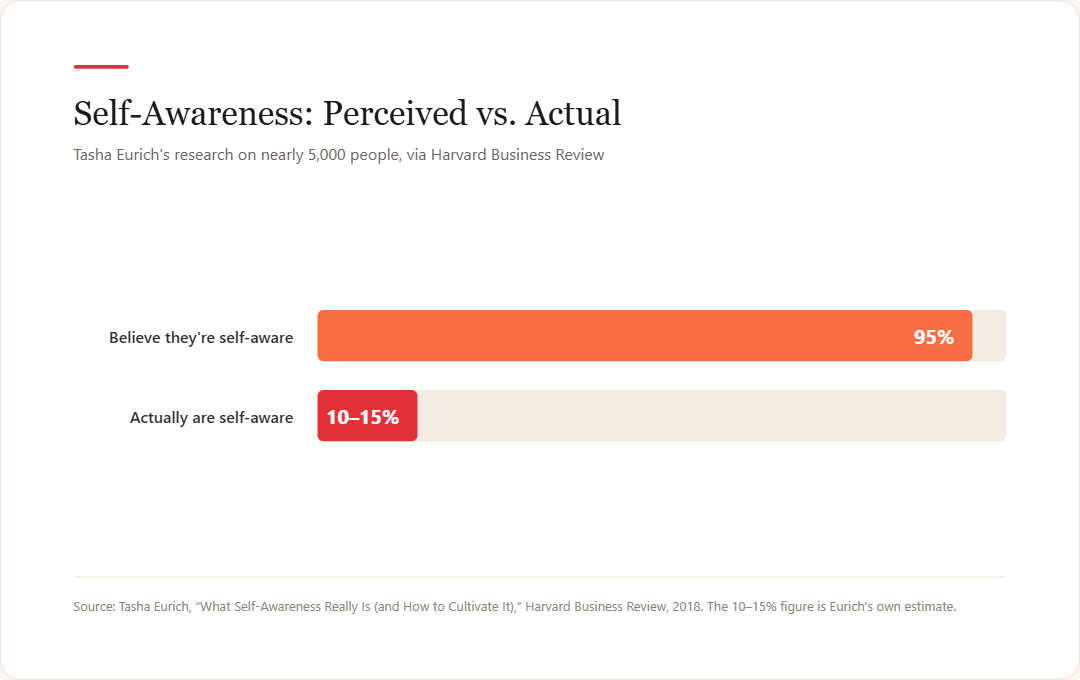
Most of us struggle to answer this because we haven’t really thought about it. Consider the research. Organizational psychologist Tasha Eurich and her team studied nearly 5,000 people and found that about 95 percent believe they're self-aware, while her team estimates only 10 to 15 percent truly are. Eurich calls that figure an estimate, but the shape of it matches what I see in my coaching.
Her work also names two distinct types of self-awareness:
how clearly you see yourself
how accurately you understand how others see you.
You can be strong in the first and still be blindsided by the second, especially as experience and power grow, because fewer people feel safe telling you the truth.
Your Brand Is Already Being Built
Now, I use the word "brand" loosely here; I don't mean a logo or a polished LinkedIn headline. I’m talking about what people say about you when you’re not in the room.
Whether we like it or not, there’s a sentence or two people use to describe each of us -
And if you don’t write that sentence, people will write it for you, often based on your worst meeting, your loudest and often most annoying habit, or the one time you were short with someone during a bad week.
"She's great in a crisis, but I never know what mood I'm going to get."
— said about a leader whose skill is real, but whose unpredictability is what people actually remember and plan around.
"He always has an opinion, even on things that aren't his call."
— said about someone whose engagement reads as overreach, so people start routing decisions around him instead of through him.
"You can tell her anything and she won't make it weird."
— said about someone whose steadiness became a reputation for trustworthiness, so people default to bringing her the hard conversations.
None of these are the kind of thing a person would put on a LinkedIn headline, and none of them are meant unkindly. They're just what slips out when someone describes you in a hallway or over drinks after work. These offhanded remarks are what makes them a truer signal of your brand than anything you'd choose to say about yourself.
The What And The How
Here's the answer I finally gave my friend about what sets me apart from other coaches and how I want to be known.
In my leadership coaching work, I do two things. First, I help clients see the unvarnished truth about what they're known for, i.e., the what, and honestly, that part isn't always comfortable.
Second, I give them concrete strategies to adjust their brand, i.e., the how, so it reflects their "true north" — the person and leader they want to be.
The "what" without the "how" is just a diagnosis. Plenty of people can tell you what's wrong, or inspire you for an afternoon, but my focus is on how you can change that perception to better reflect what you want to be known for.
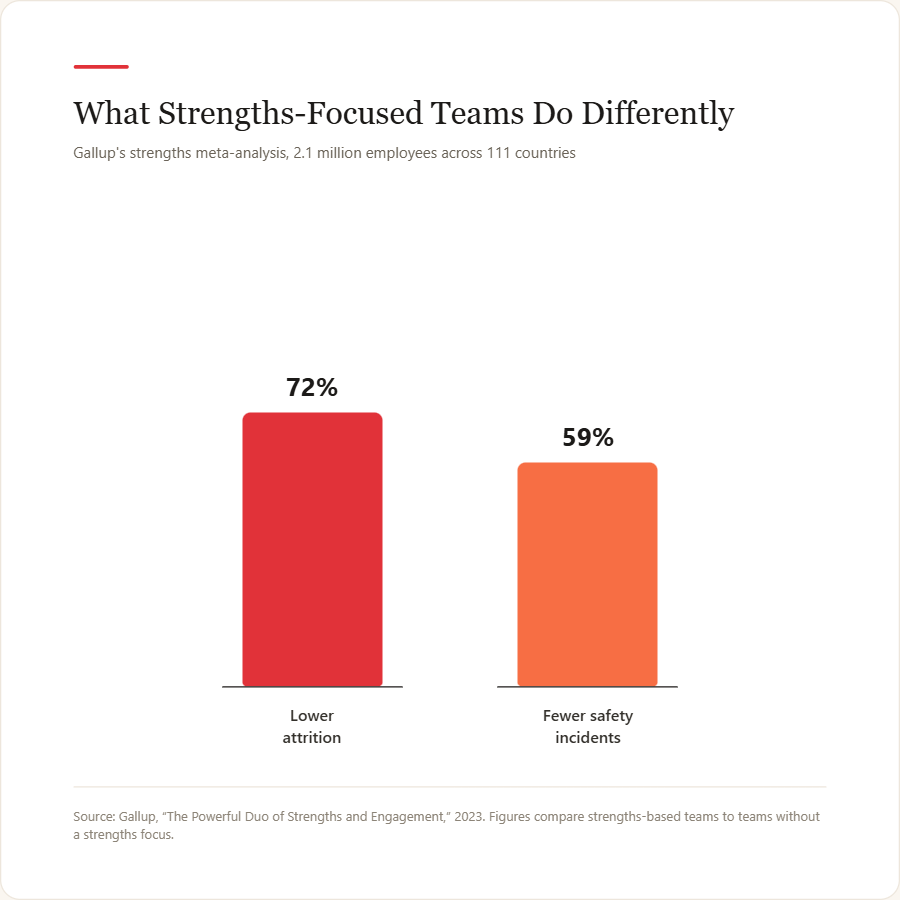
The approach starts with strengths, and the evidence for it is strong. Gallup's strengths meta-analysis, which draws on data from 2.1 million employees in 111 countries, found that teams with a strong focus on strengths development see 72 percent lower attrition and 59 percent fewer safety incidents.
Gallup notes that leaning into strengths doesn't mean ignoring weaknesses. It means helping people work through them by building on what comes most naturally. That's exactly how I coach: lean in where you're strongest, and adjust around your development areas. The same logic applies to teams, whose collective reputation works just like an individual's, which is why it shows up in our team effectiveness work too.
Here’s an example of what I’m talking about. I worked with a client who regularly shut people down, dismissed some from meetings if they asked an off-topic question, and embarrassed junior colleagues through his questions when they presented something.
His brand was that he was a downright asshole who should be avoided at all costs. After our work together, he became known as a huge supporter and developer of his team, made encouraging rather than snarky comments, and quickly became sought after for his insights.
Beyond The Job Description
Once I'd articulated my professional answer, the harder question came into view: what sets me apart as a person?
The answer sits right next to my work and goes one step further. I've always been driven to help people, at work, at play, in relationships, see the best in themselves and keep evolving. That's true of the people I coach, and it's true of my friends, my family, and, honestly, of myself - my own Myers-Briggs result shifted after twenty years of coaching! We are continually evolving.
What’s important is that "better" has to be defined by you, not by your boss, your peers, your family members or your adversaries.
What I Want To Be Known For
I keep thinking about that café and my friend’s thought-provoking question.
So here’s my answer: I want to be known as someone who tells you the truth and then stays around to help you do something with it. I want to be the person who sees the best in you before you even see that in yourself and doesn't let you settle for what could be second best. That's what I do for a living. It's also, I think, how I try to live.
So I'll leave you with the question she left me with. What do you want to be known for? And what, then, sets you apart?
If you'd like to think it through with someone, I'm always glad to talk. A discovery call is a low-pressure place to start.